Build on compatible equipment
Reuse supported RAW-capable cameras where an appropriate calibration profile is available.

Calibration-aware camera luminance
Convert supported captures from calibrated cameras into engineering luminance maps in cd/m²—ready for false-colour inspection, regional measurements, cross-sections and direct comparison.
Built for rapid engineering analysis—not as a substitute for type-approval equipment.
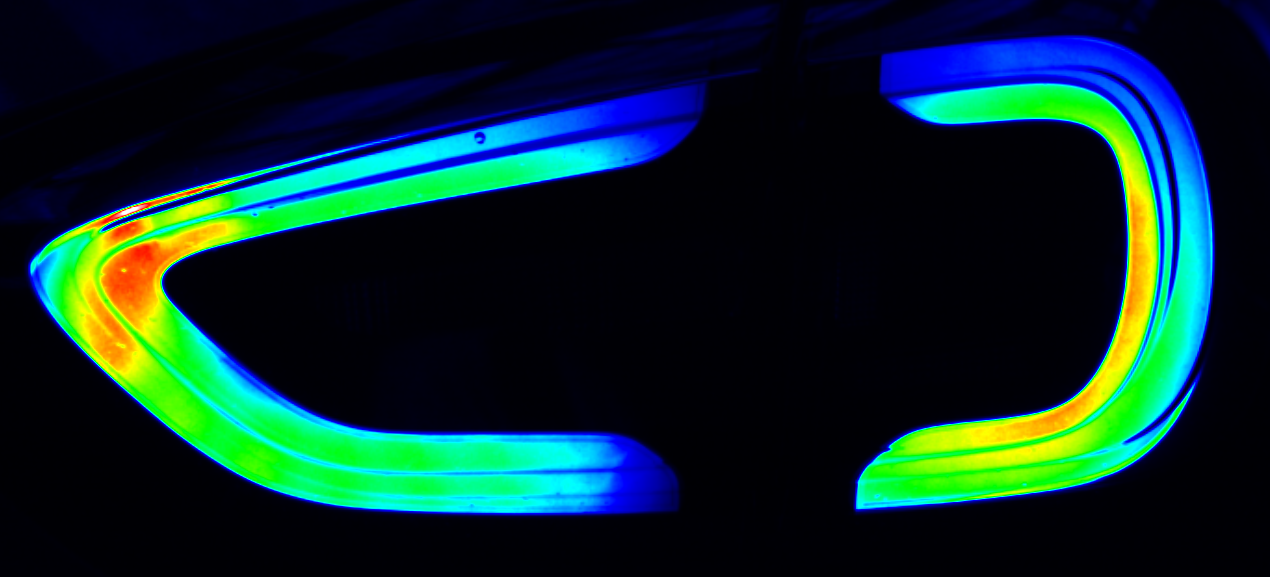
Reuse supported RAW-capable cameras where an appropriate calibration profile is available.
Inspect the underlying luminance field instead of relying on exposure-dependent presentation images.
Retain exposure metadata, calibration context and saturation checks with the engineering result.
From exposure to evidence
Capture, convert and analyse within one engineering path while keeping the calibration conditions visible.
Retain linear sensor data and exposure metadata from a compatible, calibrated camera and lens combination.
Normalise exposure, correct lens falloff and apply camera-specific luminance and colour calibration.
Load the resulting floating-point map for false colour, ROI statistics, cross-sections and comparison.
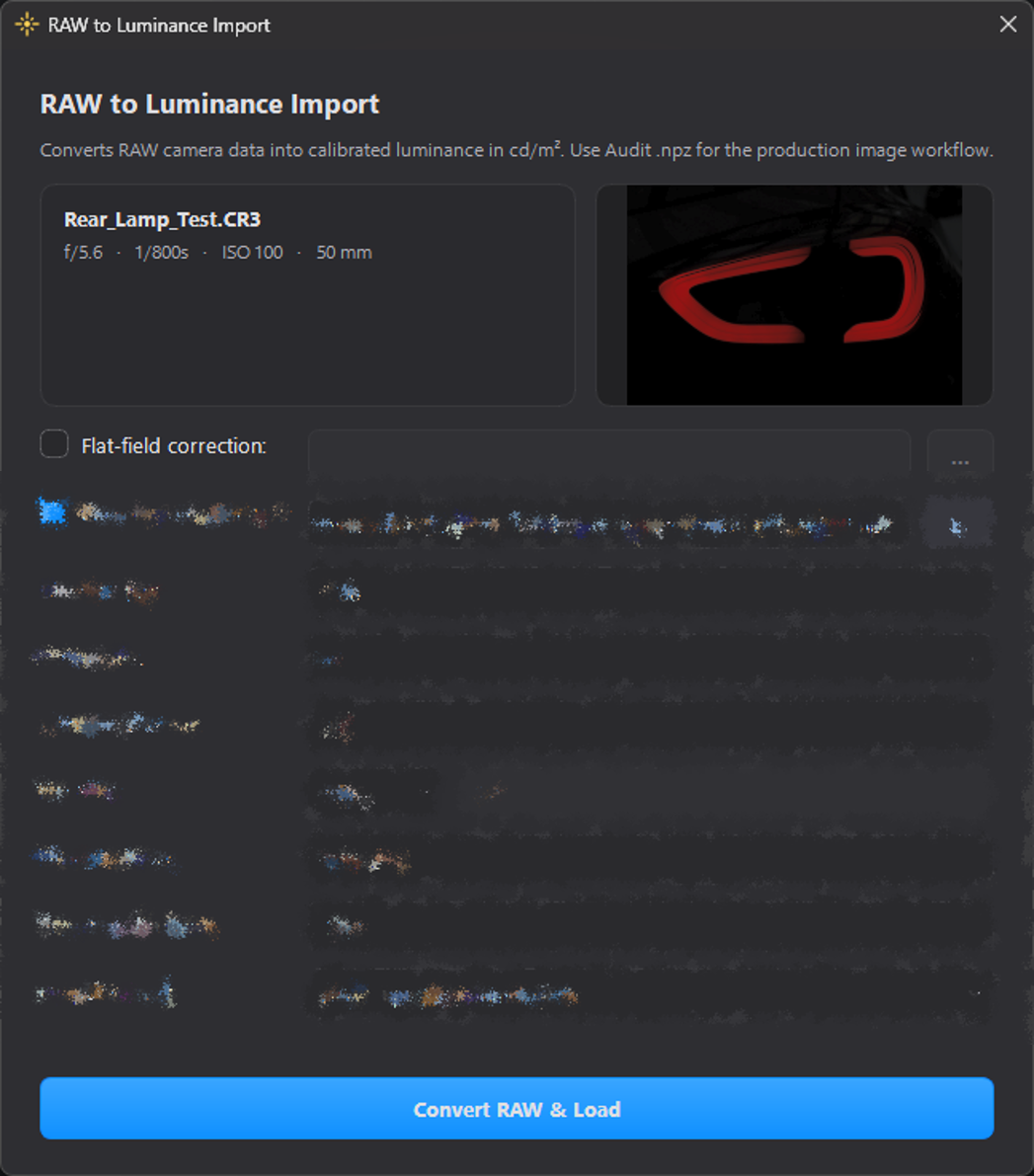
Actual quantitative performance depends on the validated camera profile, lens, capture setup and reference procedure.
Engineering outputs
Compare mean, minimum, maximum and variation over selected areas.
Inspect gradients, transitions, peaks and falloff across physical distance.
Evaluate captures through a common analysis workflow with fixed display scaling.
Flag saturated sensor regions that could invalidate peak-luminance interpretation.
Practical commercial value
Where suitable RAW-capable cameras are already available, the additional hardware requirement can be limited. The value comes from adding a calibrated capture procedure and a quantitative analysis layer to an existing imaging workflow.
This makes luminance information useful as an engineering and benchmarking aid while dedicated laboratory systems remain the reference for formal validation.
Reliable results require a validated camera-and-lens profile, reference measurements, controlled exposure, flat-field correction and checks for saturation. Ray Explorer keeps these requirements explicit; it does not claim that an arbitrary RAW file is automatically a calibrated measurement.
Technical demonstration
A short demonstration can show the conversion process, measurement tools and integration possibilities without requiring the wider Ray Explorer suite.
vitor.santiago@rayexplorer.com Vitor Santiago · Automotive Lighting Engineer & Software Developer